Aquarium
Private event — Aquatic themed costume party
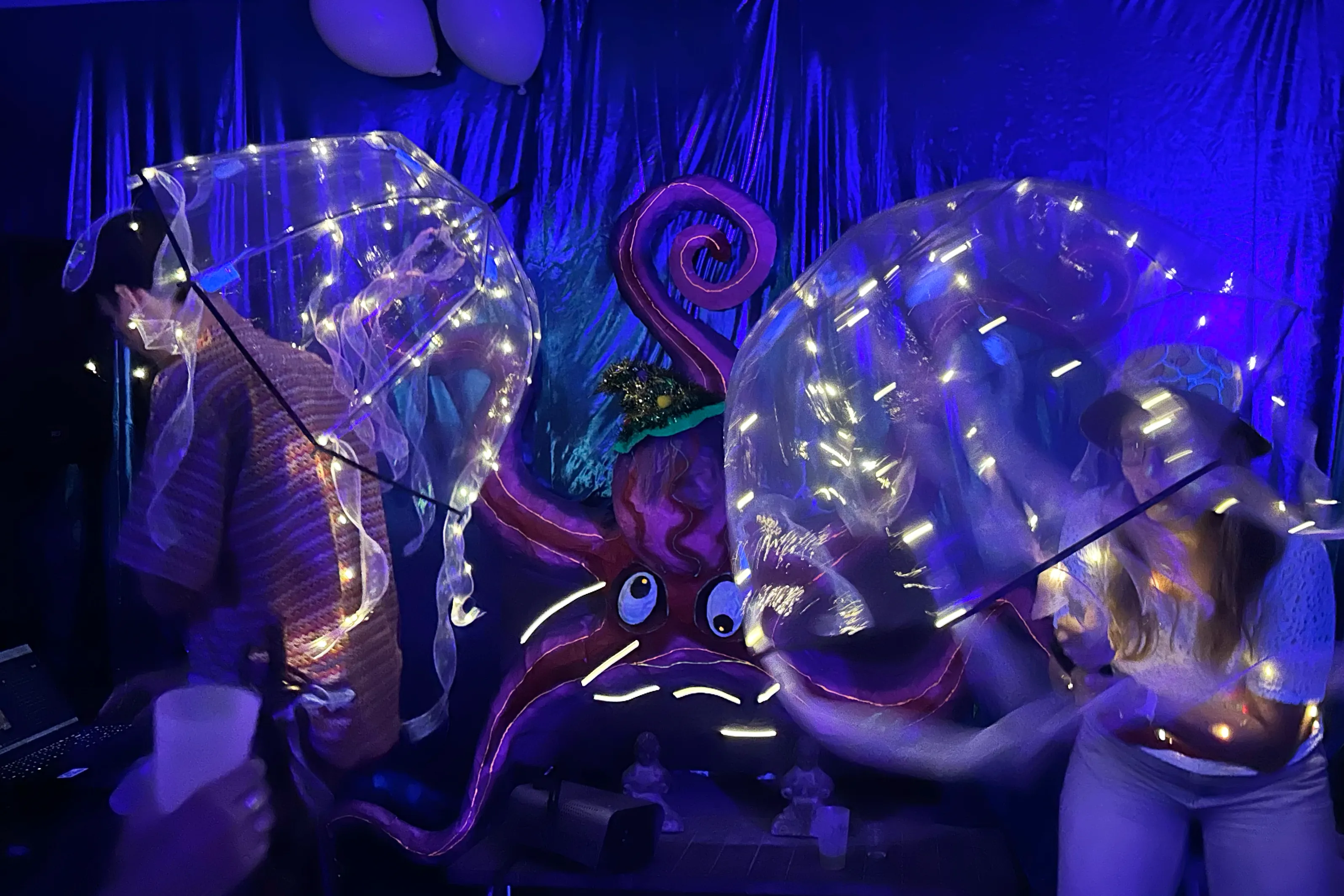
Challenge
How do you transform a plain room into an environment people will remember? For this aquatic-themed costume party, the goal was not to hang a few decorations on the wall — but to create a genuine immersive experience. To make guests feel like they had stepped inside a giant aquarium, where every element contributed to a single story.
Before anything was built, the space was studied: sightlines, circulation, and the moments that could become highlights of the experience.
Concept
The installation was organised around two complementary elements. First: a giant octopus installed behind the DJ, on the main wall of the venue. Visible from the entrance, it became the focal point of the evening — the element everything else orbited around. A plain fabric backdrop amplified its presence. Second: a field of coral pieces distributed throughout the space. Their role was not to compete with the octopus, but to gradually transform the room's atmosphere — multiplying organic forms, varied sizes, and a deliberately limited colour palette to create the sensation of being underwater without cluttering the space.
More than any single object, it was the coherence of the whole that built the immersion.
Fabrication
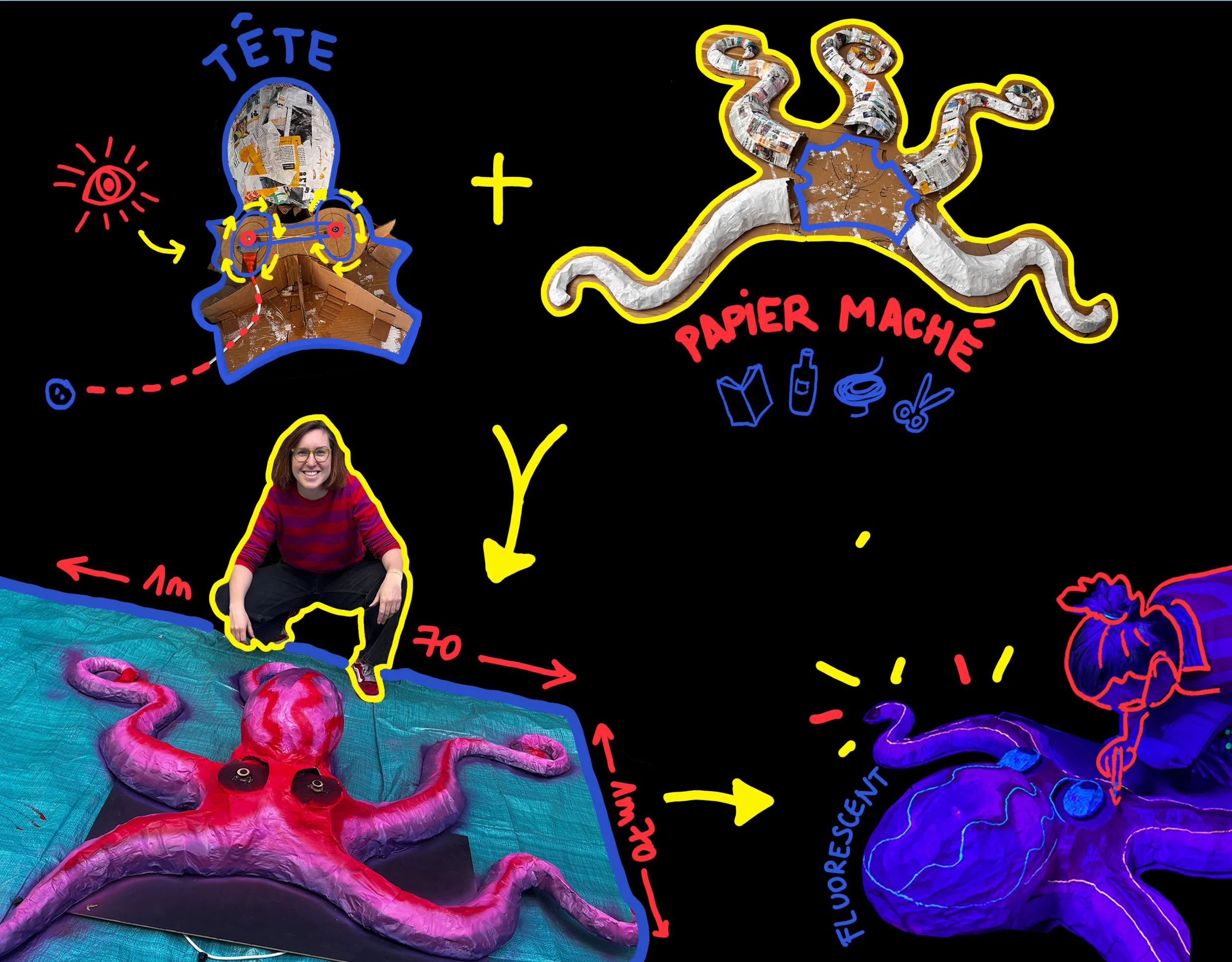
The octopus was built almost entirely from papier-mâché. Each tentacle was made separately, then assembled with the head directly on site — allowing a piece measuring 1.70 m tall, 1.70 m wide and 80 cm deep to be transported in parts. Midway through the build, a decision was made to give the octopus rotating eyes. Rather than buying an off-the-shelf mechanism, one was built from salvaged parts: a DC motor, a recovered ball bearing, and a belt cut from an old bicycle inner tube. Simple, reliable, nearly invisible.
Apart from a few MDF sheets and spray cans, almost all materials were salvaged: cardboard, paper, glue, mechanical parts, inner tube.
The coral pieces were designed for CNC cutting in 10 mm MDF, using mortise-and-tenon joints assembled in a cross configuration — stable enough for a dancefloor, fast to assemble and disassemble.
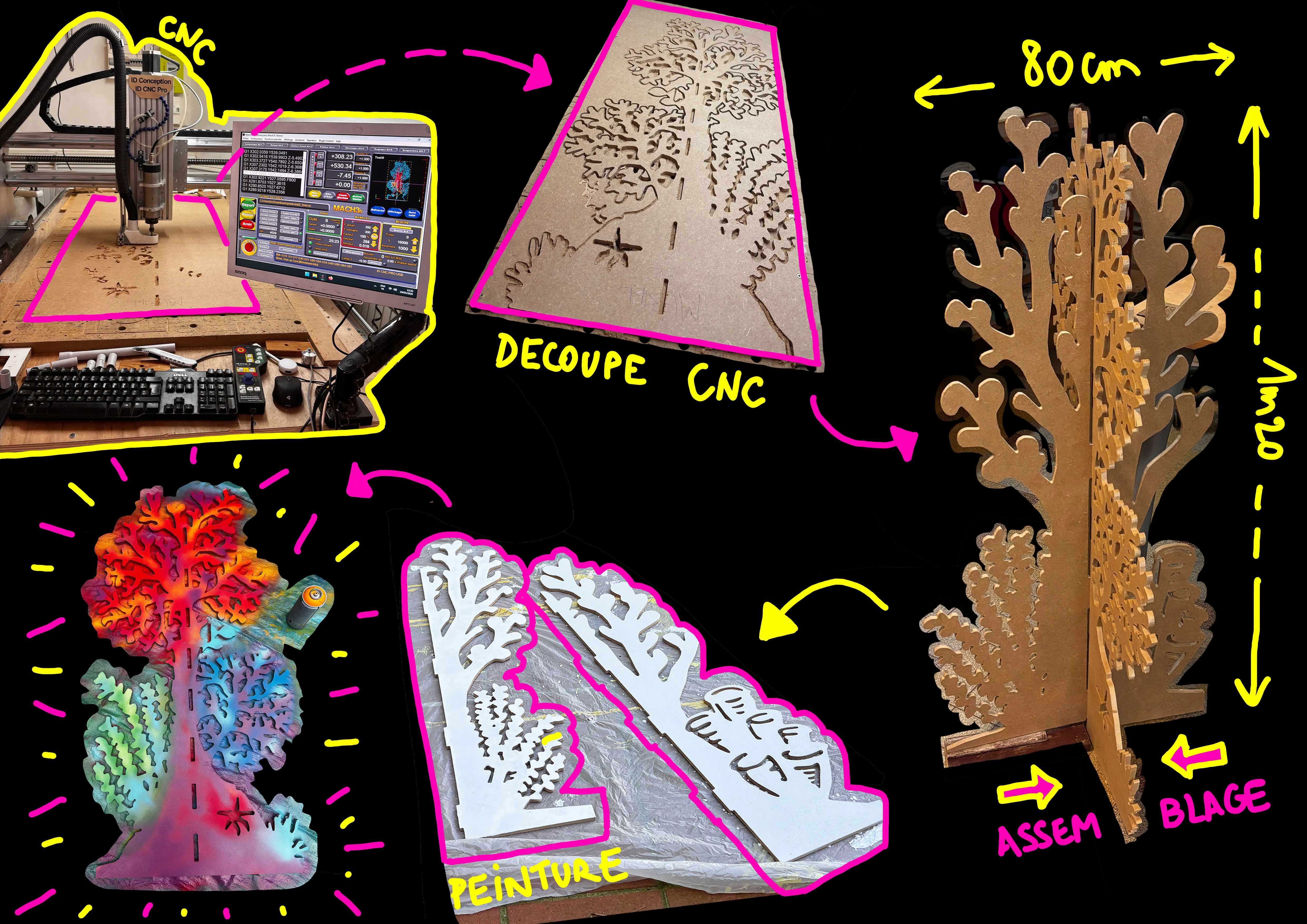
After cutting, each piece received multiple layers of spray paint to build depth, then phosphorescent motifs that appear only under black light.
Light
Phosphorescent paint, revealed by UV black light, gives the installation a double reading: a colourful daytime version, and a deep-sea phosphorescent version at night. The shift at nightfall — when the UV lights come on — was designed as a moment of surprise in itself.
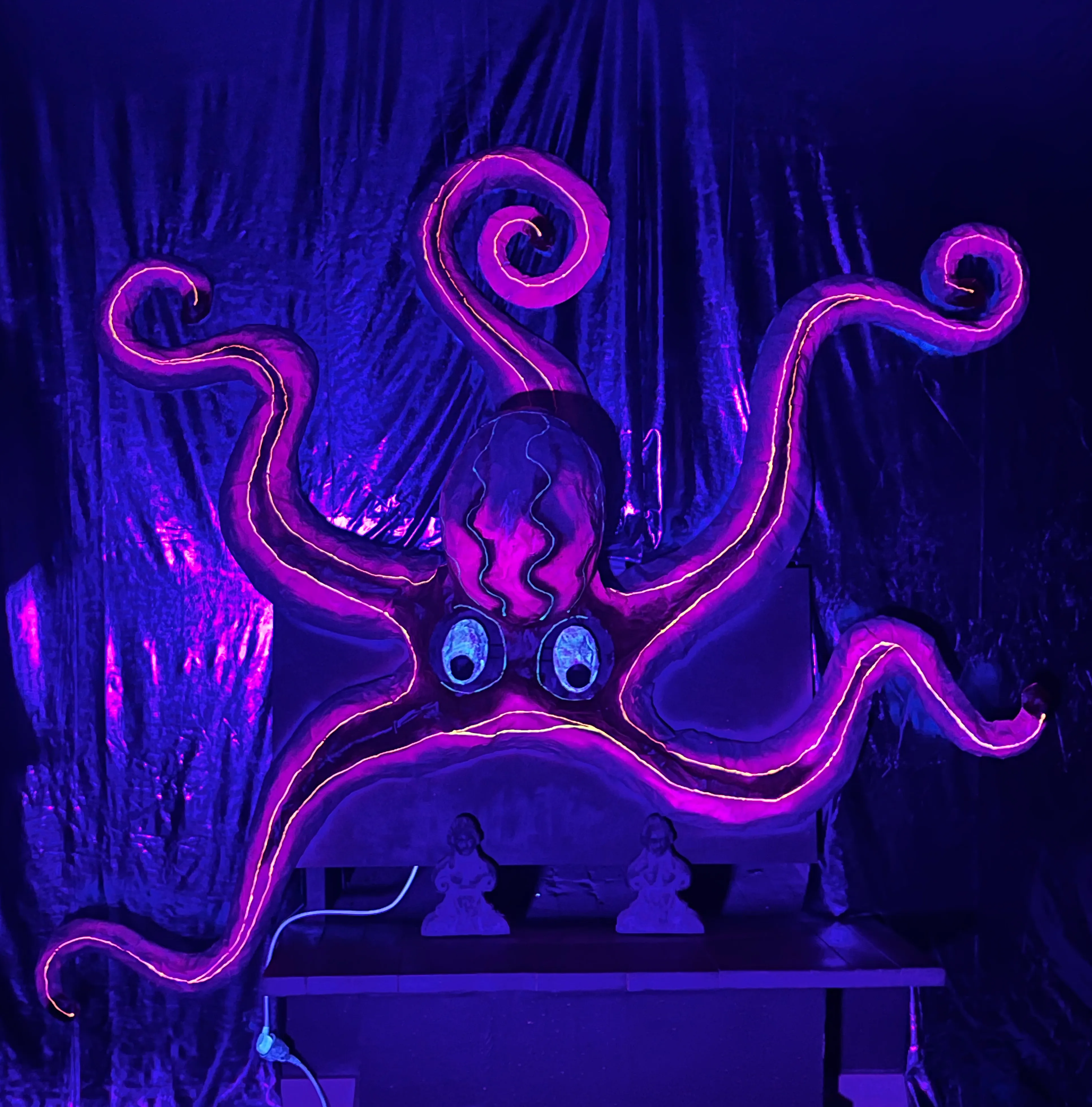 Night
Night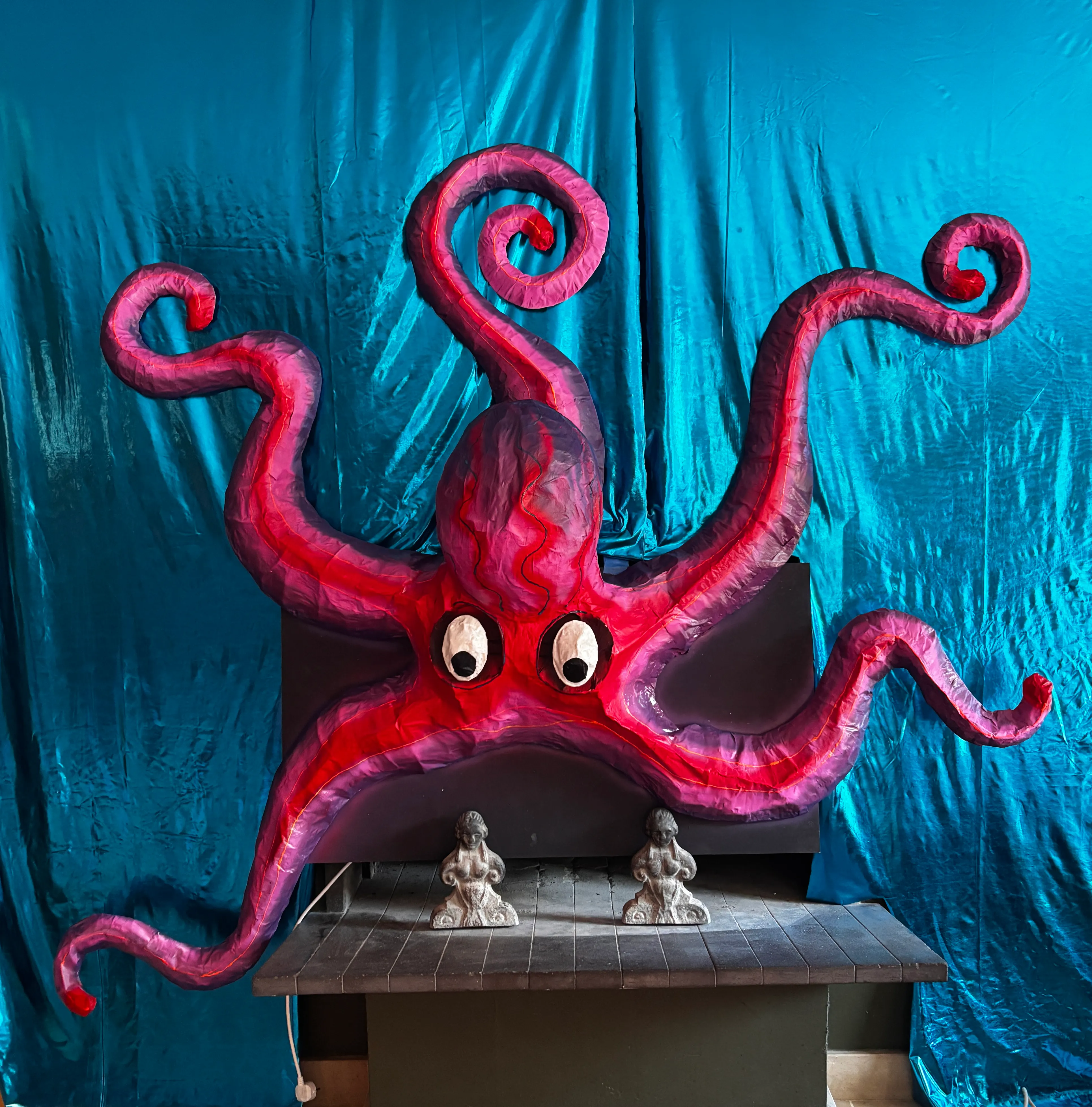 Day
Day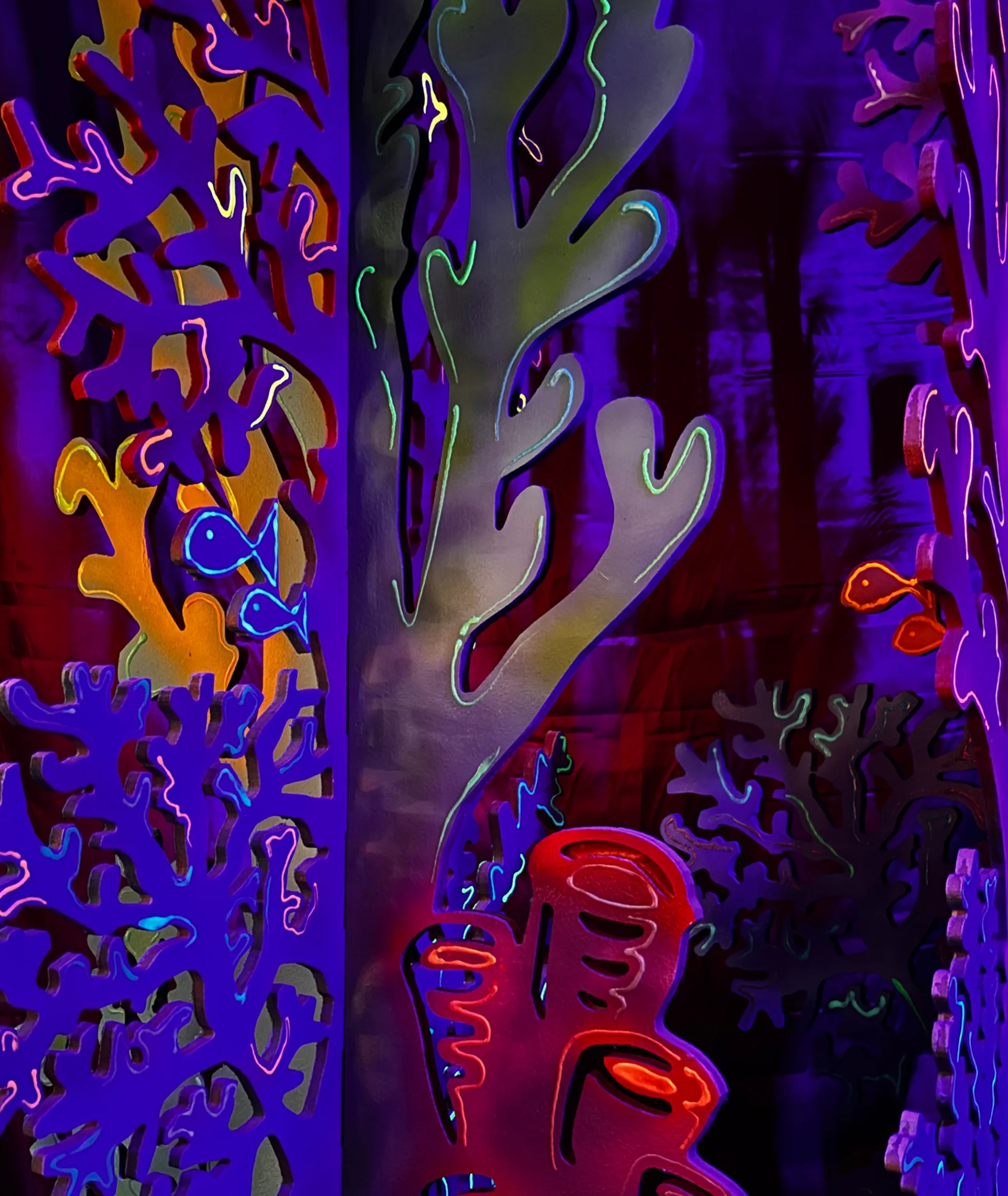 Night
Night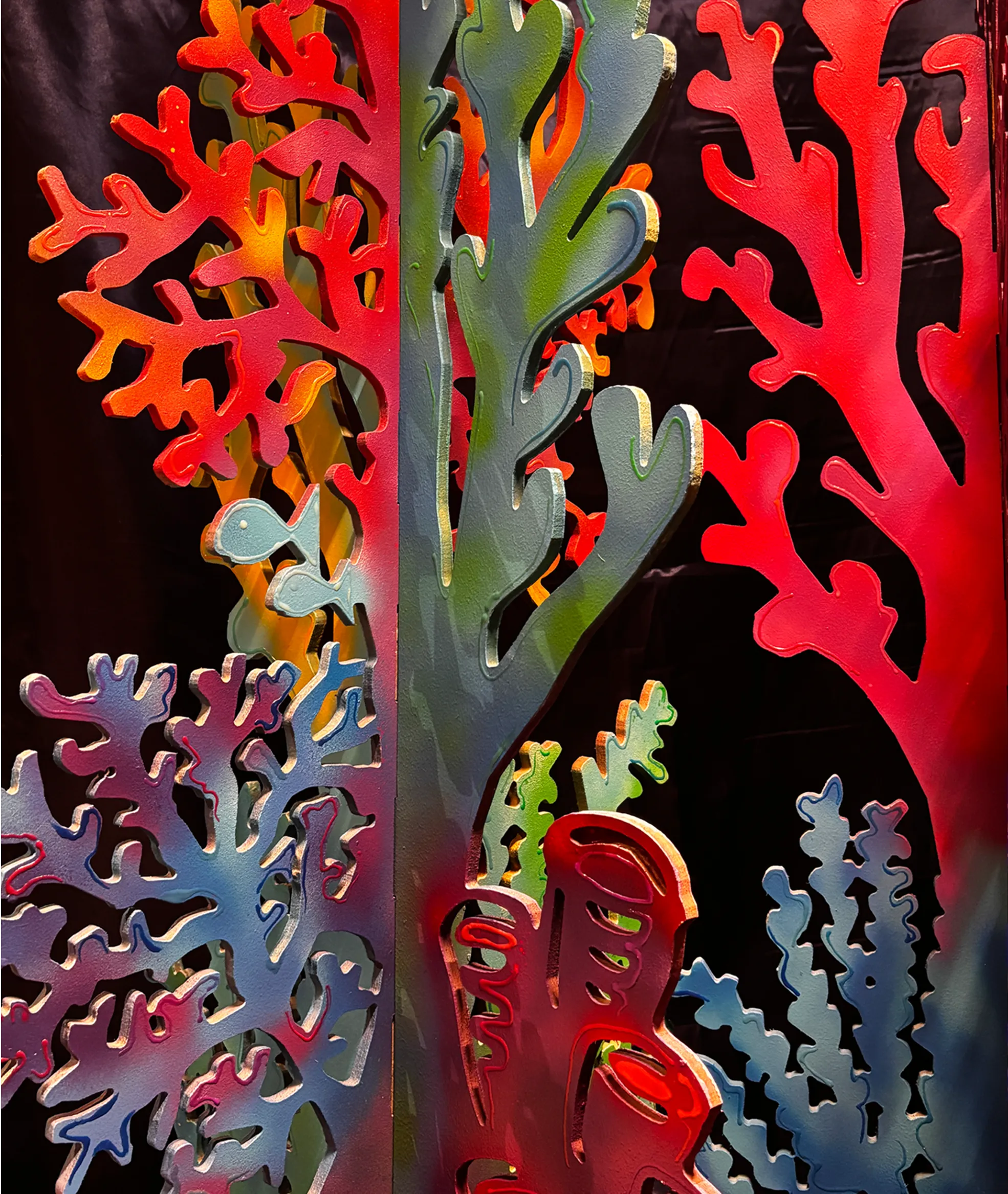 Day
DayA little bonus: the octopus's eyes really do turn!
Role
- Scenographic design
- Fabrication of the pieces
- Installation and staging of the space
Skills