Jewelry Stand
The challenge
I have always struggled to find a jewelry stand that was both practical and joyful.
Most products on the market are designed for a single type of jewelry, or prioritize aesthetics over functionality. I wanted to create an object that could hold rings, necklaces and bracelets at the same time, while bringing a bit of personality to an everyday object.
The challenge wasn't only aesthetic. I also wanted the product to be easy to manufacture, ship flat, assemble without tools, and make efficient use of materials.
The approach
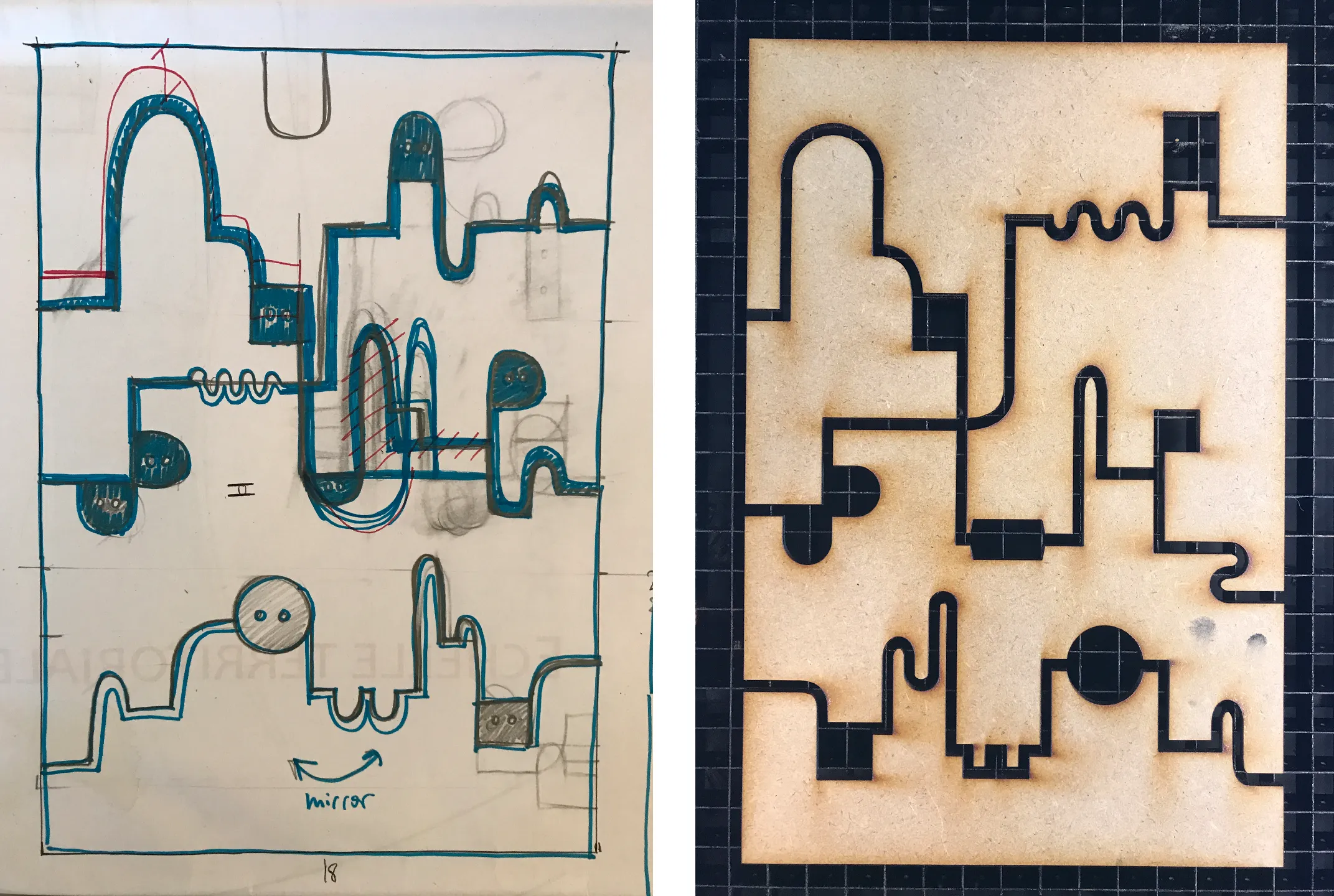
The project started with a simple sketch inspired by exposed pipework.
I liked the playful, almost cartoon-like silhouette. It naturally created multiple hanging points while giving the object a recognizable character.
From there, the manufacturing process became part of the design itself.
Because the object would be laser-cut from 3 mm MDF sheets, every shape, joint and dimension had to respect the possibilities—and limitations—of this fabrication method.
Rather than designing freely and adapting the production afterwards, I designed directly with the manufacturing process in mind.
Designing for fabrication
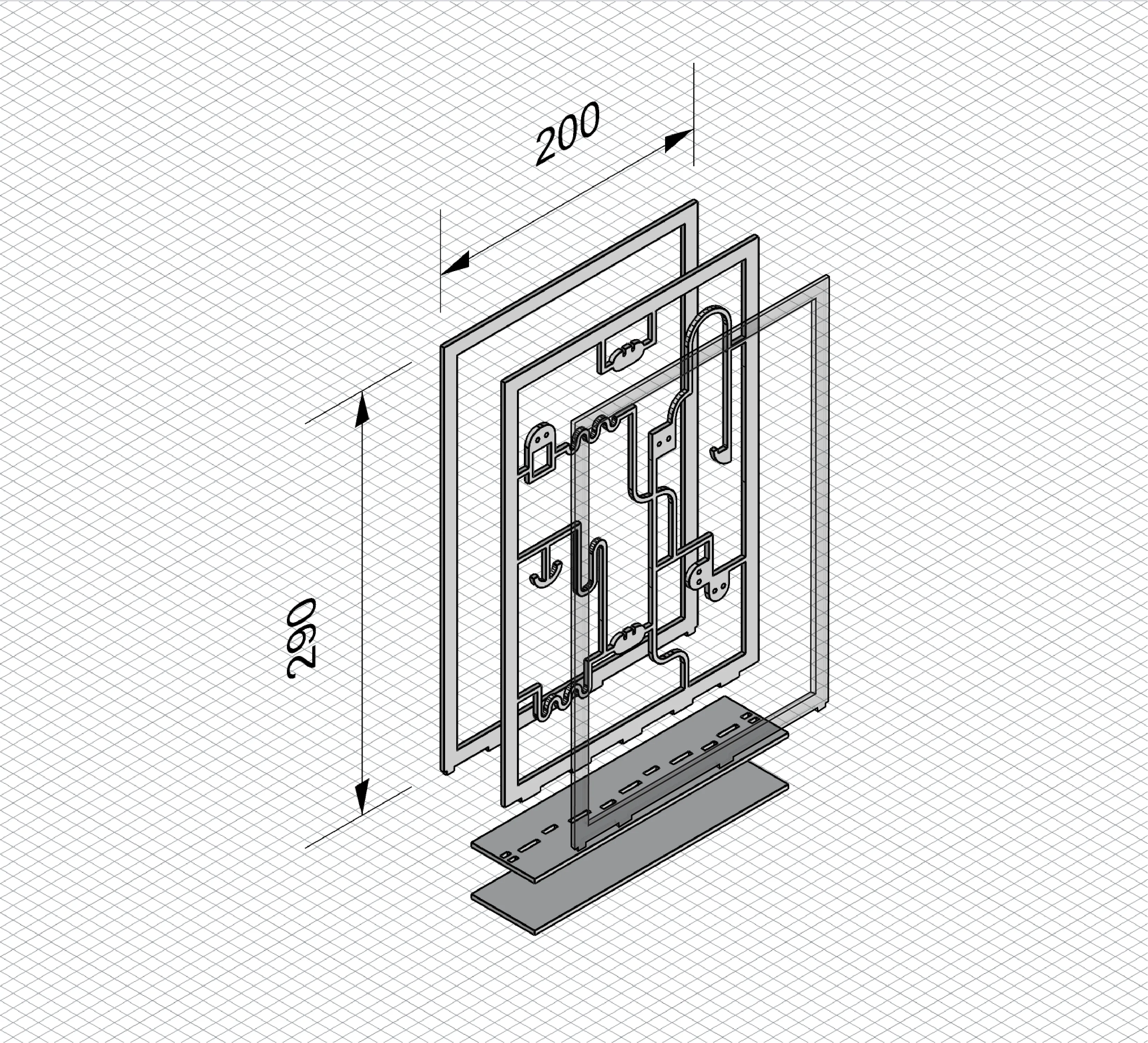
The final object is composed of only four parts:
- one central panel forming the jewelry stand,
- two side panels creating the frame,
- one removable base.
The assembly relies on a simple mortise-and-tenon system reinforced with glue, making the product straightforward to manufacture and assemble.
Keeping every component flat also meant the entire product could be shipped in a thin cardboard package, reducing both packaging volume and transportation costs.
I also tried to optimize the cutting layouts to reuse leftover MDF sheets whenever possible, making small-scale production more material-efficient.
Iteration
The first prototype quickly highlighted several weak points.
Some elements proved too fragile, while others needed to better support the weight of necklaces and bracelets.
These observations led to a second iteration with a more robust geometry and cleaner proportions.
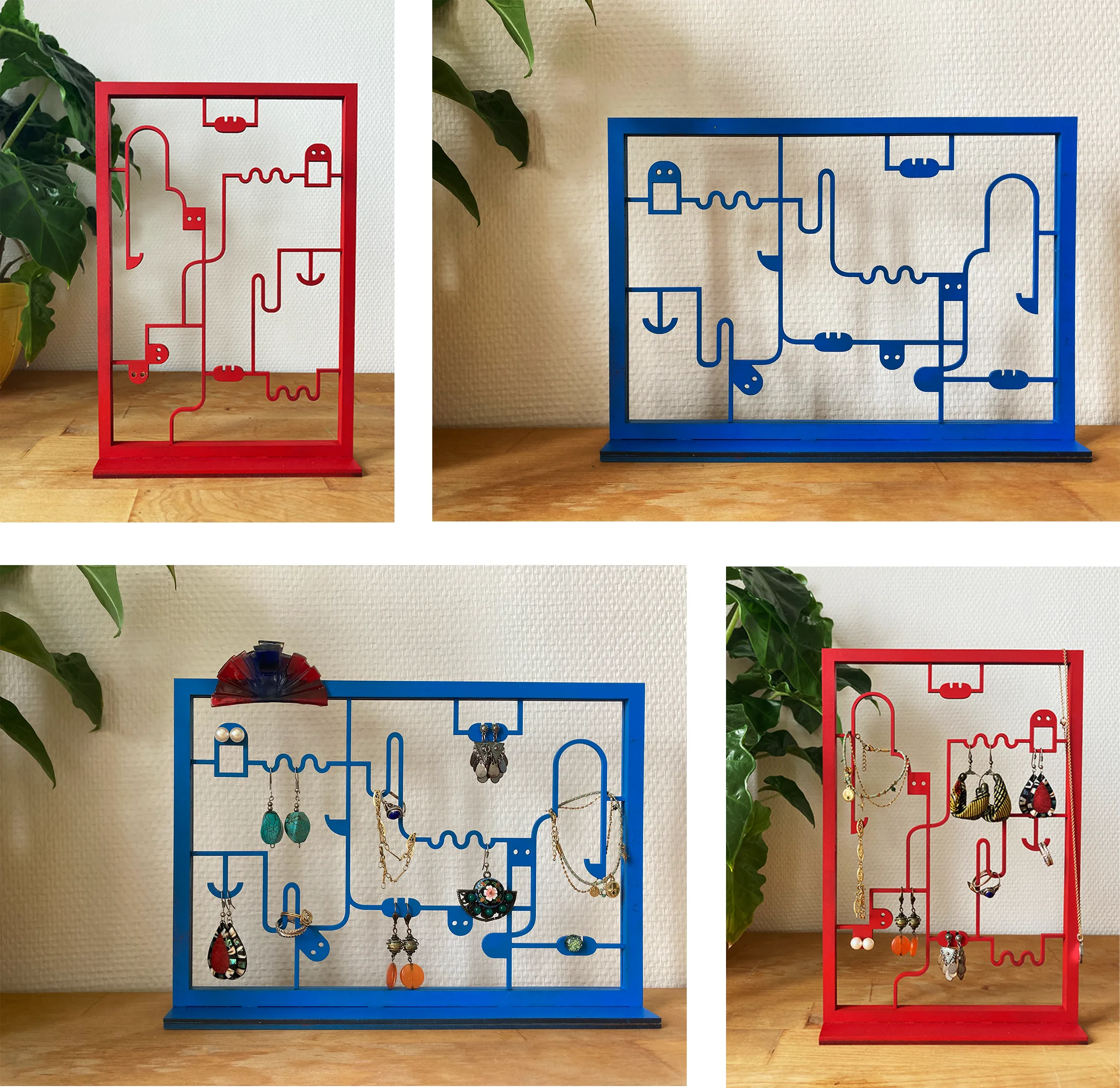
Once the structure was validated, I explored different colour combinations and developed two formats—a portrait and a landscape version—to offer different ways of displaying jewelry.
Reflections
With this project I learned that it is not too complex to design a beautiful, fun and functional object. And I loved creating this very personal object, that I find funny and colorful.
I produced a few of them, and offered them to my friends, but I never really made it to selling and mass-producing. If you wish to have one, let me know and I'll make it for you!
If I were to continue developing the product, I would redesign the base in metal to improve stability and explore a wall-mounted version that could function as both storage and decorative object.
Role
- Personal project — design, prototyping and fabrication
- Product design
- Fabrication and small-series production
Skills